

Pillar 4: Creative Integrity and Longevity
Creative Integrity and Longevity bring the framework's principles into long-term practice.

This pillar asks a forward-looking question:
How does a photographer use AI in a way that strengthens creative identity rather than diluting it?
Protecting Creative Identity
AI systems can generate endless variation. Style can shift quickly. Aesthetic direction can change in minutes.
Creative integrity requires continuity.
It means:
Developing a recognizable visual voice
Maintaining thematic coherence
Allowing experimentation without abandoning identity
Making deliberate choices about how far a transformation should go
Without discipline, generative tools can fragment a body of work.
With discipline, they can deepen it.
Avoiding Generative Drift
One of the easiest traps in AI workflows is drift.
An image evolves. Variations multiply. The transformation becomes increasingly removed from the original intent.
Drift often feels productive in the moment. It feels exploratory.
Over time, it can erode consistency.
Creative longevity depends on knowing when iteration refines vision and when it replaces it.
The question is not whether AI can push further.
The question is whether pushing further serves the work.
Building a Cohesive Body of Work
For fine art photographers especially, sustainability is measured in bodies of work, not isolated images.
Creative longevity requires:
Consistency across collections
Thoughtful integration of new techniques
Awareness of how AI transformations sit beside traditional captures
Clear authorship across evolving styles
AI can expand vocabulary. It should not erase authorship.
The strongest portfolios are those where innovation feels integrated rather than inserted.
Sustainability in Practice
Longevity also has a practical dimension.
Creative work must remain viable for:
Exhibition and large-format printing
Professional presentation
Long-term archiving
Audience trust
When creative identity remains clear, sustainability follows more naturally.
Reputation grows from coherence.
Where The 4 Pillars Leave Us
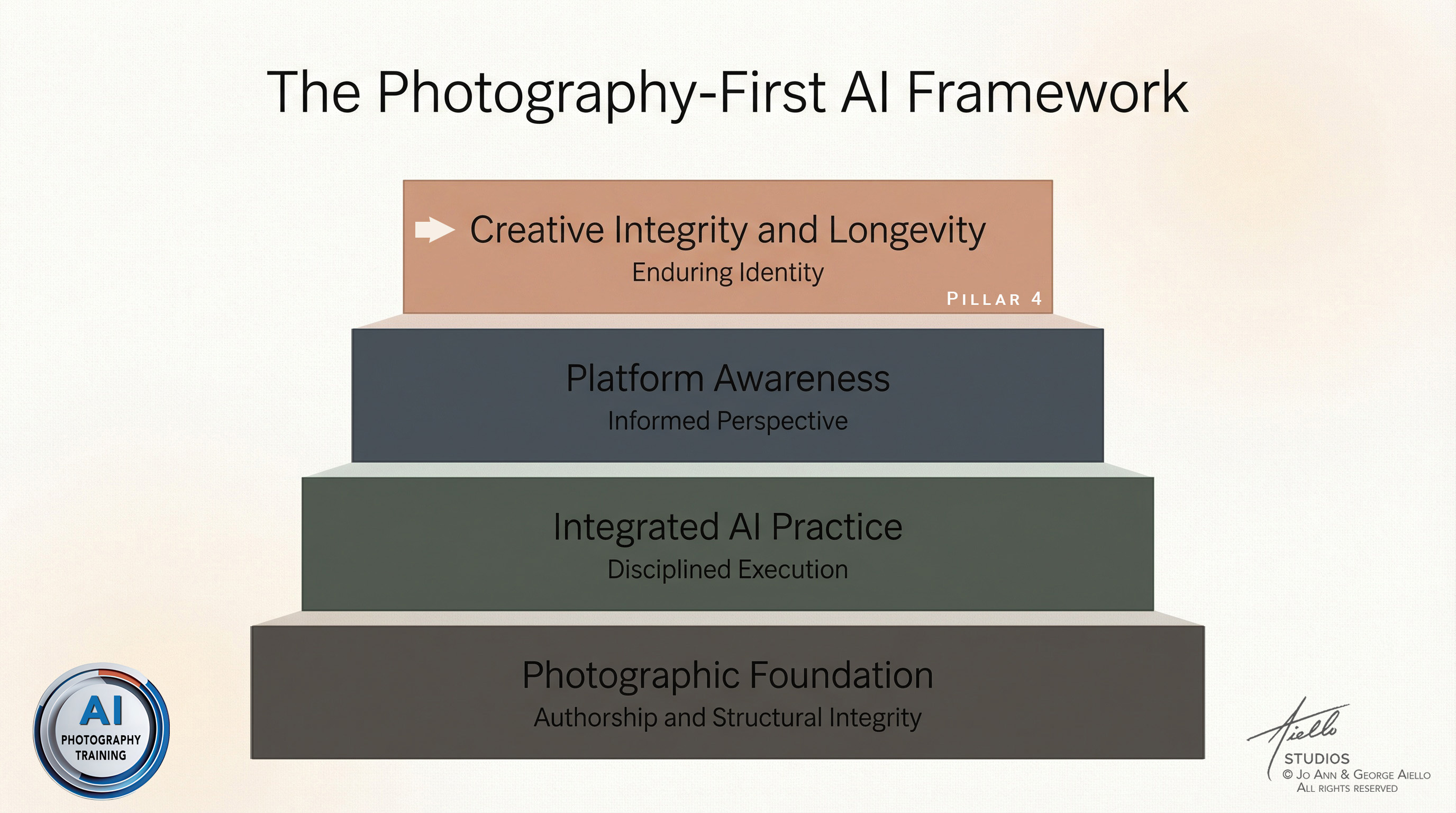
Pillar 1: Photographic Foundation establishes authorship.
Pillar 2: Integrated AI Practice establishes disciplined execution.
Pillar 3: Platform Awareness establishes an informed perspective.
Pillar 4: Creative Integrity and Longevity ensure that the work remains cohesive and enduring.
Together, these four pillars form the Photography-First AI Framework.
They are not about resisting technology.
They are about preventing technology from redefining vision without intention.
Having worked through the Photography-First AI Framework and its four pillars, you now have structure. You are not approaching AI from curiosity alone, but from authorship, discipline, awareness, and creative continuity.
With that foundation in place, the tools become clearer. The experimentation becomes more purposeful. And the work remains your own.
With the Photography-First AI Framework in place, you can now explore AI with structure, clarity, and confidence in your authorship.
Thank you for reading.
And remember… Stay Curious. Keep Exploring. And most of all, Enjoy Creating!
Jo Ann & George Aiello
Aiello Studios