
If You’re Confused About AI’s Value or Threat to Photography, You’re in Good Company
A look at AI in photography: What’s real, what’s hype, and how to use it.

If you’ve been feeling uneasy or just confused about artificial intelligence and what it means for photography, you’re far from alone. Many photographers — even seasoned pros — don’t fully understand what AI is, what it can (or can’t) do, and whether it’s a threat or an opportunity.
Before we go further, it’s worth noting that this isn’t about AI’s broader risks. For example, the headlines about misinformation, automation, copyright, or government regulation. Those are important discussions, but they’re not what this article is about. Here, we’re focusing on how AI intersects with art, specifically, photographic art, though the same questions echo through music, writing, and filmmaking.
The conversation around AI and creativity has been so loud and so polarized that it’s easy to feel like you’re supposed to take a side. Some say AI is destroying art; others insist it’s the best thing to ever happen to creative expression. The truth, as usual, lies somewhere in the middle and can differ for each person.
For most photographers, the real issue isn’t fear; it’s confusion.
Why So Many Photographers Feel Stuck
Photography has always been tied to technology. From film to chemistry to digital sensors, from dodging and burning to Photoshop layers, every generation has had to adapt to a new set of tools. But AI feels different.
It’s not just a new editing feature or camera upgrade; it’s a new way of thinking about how images are made. And that can be uncomfortable.
Add to that a flood of misinformation online. Some call AI “soulless,” others call it “magic.” It’s no wonder photographers are unsure where they stand. Many quietly wonder:
If I use AI, am I still a photographer?
Will clients or collectors take me seriously?
What happens to originality when AI is involved?
These are fair questions. But they’re also rooted in assumptions about what AI actually is, and what it isn’t.
If you’re enjoying this article and would like to receive all of our AI Photography Training content, consider becoming a free or paid subscriber.
What AI Really Is (Without the Tech Talk)
Despite the buzz, AI isn’t some mysterious force replacing human creativity. At its core, it’s a pattern-recognition system. It studies millions of examples and learns to predict what might come next. Whether they should have the right to do that, or under what circumstances, is a whole other debate. One that I’m very concerned about and have often written about in this Substack.
When AI removes noise from an image, reconstructs a background, or adjusts lighting automatically, it’s not inventing beauty from nothing; it’s analyzing patterns and applying them intelligently based on your reference image(s) and instructions (prompt).
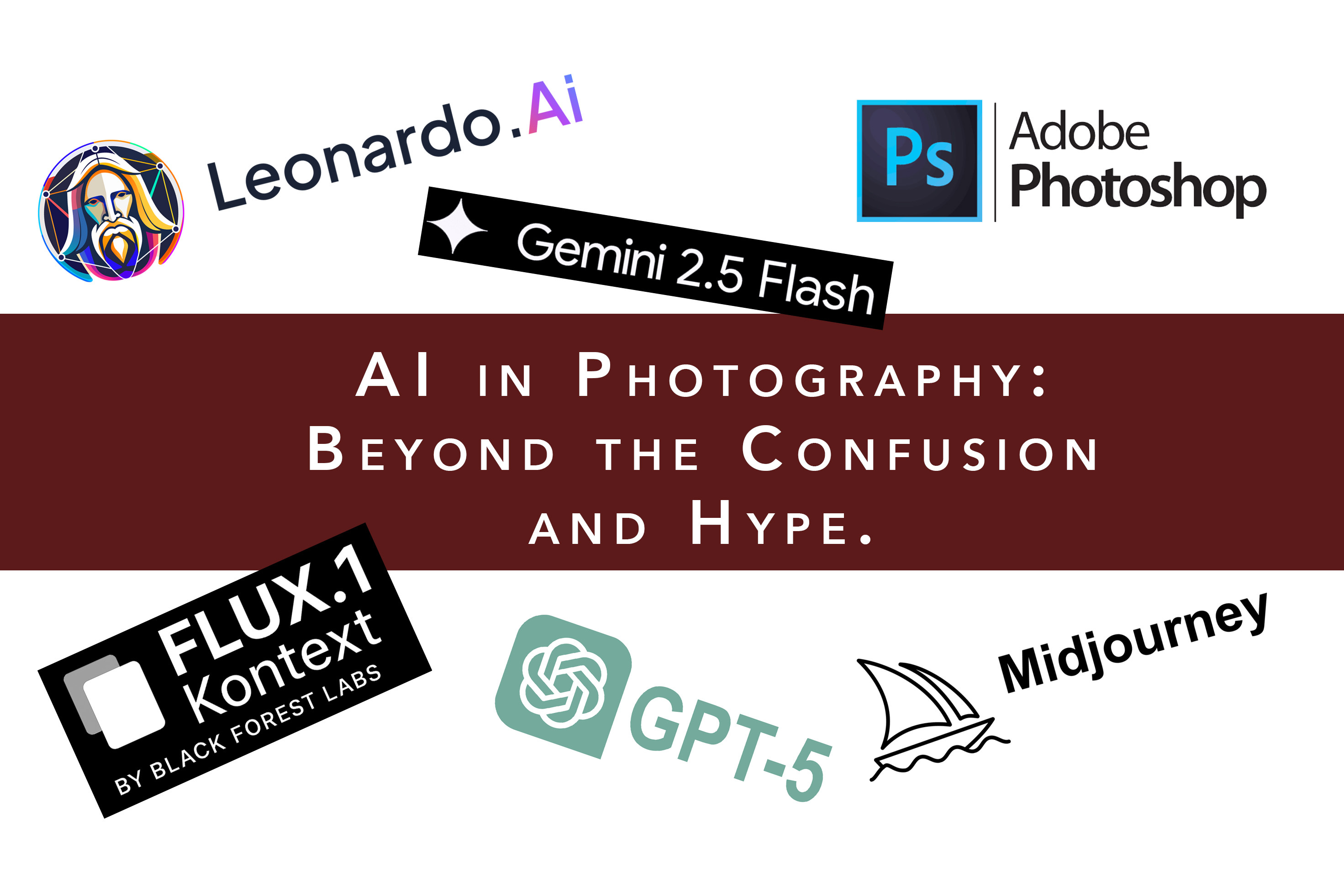
You’ve likely already used AI tools without realizing it: Photoshop’s Remove Tool, Generative Fill, Topaz Photo AI’s sharpening, Gigapixel, or Lightroom’s Select Sky feature all rely on AI models under the hood. They’re not stealing your creative control; they’re saving you time and improving consistency.
In other words, AI is already part of photography. It’s just been quietly helping in the background.
Let’s not confuse prompt-only image generation with photographic art.
There’s a growing flood of AI-generated “photos” online that were never captured in-camera. They can look convincing, but they’re not photography, not the photography I’m talking about. Good or bad, they’re illustrations created through text-based synthesis. I’m not criticizing that. It’s just a different thing. And yes, some are amazing!
Photographers using AI as part of their editing or creative process are working from actual images they composed and exposed themselves. The distinction matters: one begins with vision and a camera; the other starts with words and algorithms. The one thing they have in common is that both often start with an idea.
Oh, and then there’s a third category — when a real photograph becomes something that could never exist in reality. We do this very often. Maybe colors shift into surreal tones, elements are added or removed, or the scene transforms entirely. This is where we stop calling the work a photograph and start calling it digital art. It still originates from a genuine photo, but it’s been reimagined into a new visual statement. We often refer to this mix of photograph and imagination as “using the camera as a sketchpad.” There’s still an original photograph at the heart of the image, even if it may not be obvious.
Understanding these distinctions: photography, AI-assisted photography, and AI-transformed digital art, helps keep our creative roles clear. Each has value, each is a valid art form, but they’re not the same thing.
Misconceptions Worth Letting Go
Let’s address a few of the big myths photographers often repeat:
Myth 1: AI-generated or AI-assisted art isn’t real art.
To my way of thinking, art isn’t defined by the tool; it never has been. It’s the intent behind it, your intent and your vision, that defines it. The same argument was made when digital replaced film, or when Photoshop became mainstream. Human judgment — what to keep, what to change, what to express — still determines whether something resonates.
Myth 2: AI replaces the photographer.
It can’t. AI has no personal experiences, no vision, and no sense of timing. It can mimic aesthetics, but it can’t see the way you do. What it can do is help you experiment faster, visualize ideas, refine, or even transform what’s already in your image and mind’s eye.
Myth 3: Using AI is cheating.
Editing has always been a creative act. Whether through darkroom manipulation or digital retouching, photographers have long used whatever tools were available to them to guide the viewer’s eye and emotion. Used with intent, AI simply offers new ways to achieve similar goals.
A Better Way to Think About It
Instead of asking whether AI is good or bad, it may be more useful to ask: How can I use it to support my work?
For some, that might mean subtle editing, such as cleaning up distractions, restoring sharpness, or refining tones. For others, it might mean creative transformations, like reimagining an original photo into a painterly or abstract digital artwork.
Either way, AI should never feel like a replacement for seeing. It’s a compliment, an extension of your creative process.
The key is understanding what’s happening behind the curtain, so you can make informed decisions about when and how to use it.
Learning to See — Again
The real power of photography has always been in the act of seeing, recognizing light, balance, emotion, and meaning in a scene. AI doesn’t change that. It only adds new ways to interpret and communicate what you already see.
Understanding AI doesn’t mean you have to use it. But not understanding it means missing out on one of the most significant shifts in image-making since the move to digital.
And as with any major change, the best approach isn’t to reject or embrace it blindly; it’s to learn what it is, how it works, and what fits your goals as an artist.
And that brings me to a shameless plug. A Personal, Hands-On Way to Learn
If you’ve been curious about AI but don’t know where to start, we’re now offering one-on-one sessions designed specifically for photographers. These aren’t arcane tech tutorials, abstract overviews, or promotion of any particular platform. Instead, they’re practical, conversational sessions where we walk through the platforms, tools, and examples together.
You’ll learn:
What different AI tools actually do (and what they don’t)
How they fit into a photographer’s workflow
How to maintain artistic integrity while using AI creatively
Whether you’re just exploring or ready to integrate AI into your practice, you’ll come away with clarity, confidence, and real-world direction.
Where That Leaves Us
AI isn’t killing art, but it is fair to say it’s testing our understanding of what art really means. And that’s something every generation of photographers has faced.
The tools have changed, but the impulse hasn’t: to observe, to interpret, and to create something that feels true.
If we approach AI with that same mindset — curiosity instead of fear — we might just find it’s not an ending, but an expansion of what’s possible.
Thank you for reading.
And remember… Stay Curious. Keep Exploring. And most of all, Enjoy Creating!